
Arizona's third-largest city, settled in 1878
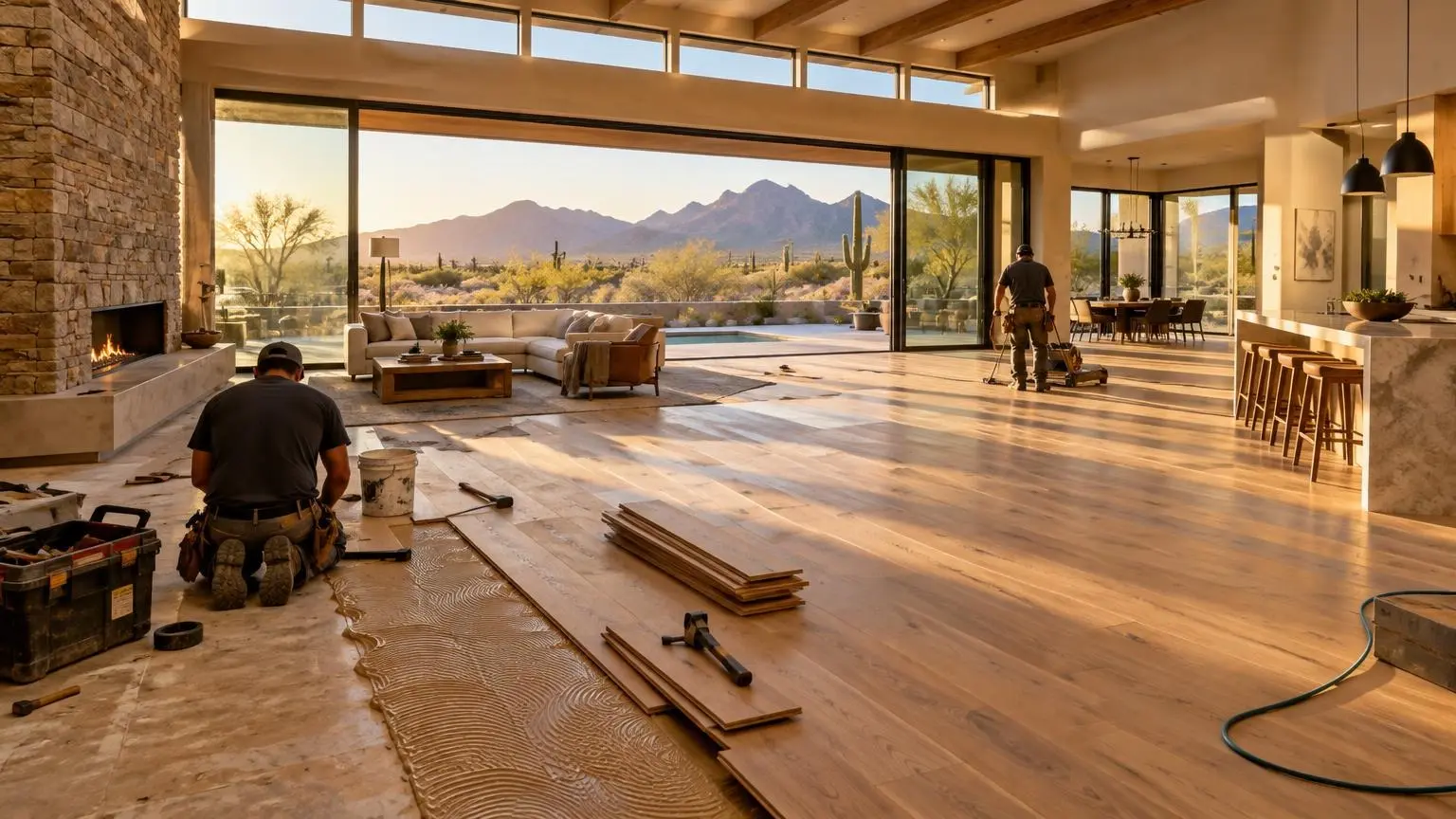
Hardwood Flooring in Mesa, AZ
One city, several eras of housing, and a different starting point for the floor in each.
- Free on-site estimates with wood and slab moisture readings
- Written, itemized quotes that list every room and product
- Acclimation and install method planned for desert humidity
Mesa Houses Span Decades, and So Do Their Floors
Hardwood Flooring in Mesa is not one kind of job, because Mesa is not one kind of neighborhood. The city counted 504,258 residents at the 2020 census across more than 139 square miles, and Center Street splits it into West Mesa and East Mesa. Houses near the old townsite and Main Street come from a very different period than the subdivisions built out toward Phoenix-Mesa Gateway Airport. Before we talk species or plank width, we want to know which Mesa your house is in.
Decades of growth, layer by layer
Mesa grew slowly at first. It was registered as a one-square-mile townsite on July 17, 1878, and had 7,224 people in 1940. Then the two wartime airfields brought military personnel, and the arrival of air conditioning and tourism set off rapid growth: 16,790 in 1950, 33,772 in 1960 and 63,049 in 1970. Every one of those waves left behind homes that are now aging on their own schedule. A ranch house from the 1960s may have had its original floor coverings replaced several times; a house from the 2000s may still have builder carpet and tile that the owner is ready to pull.
What that means for your project
- Older West Mesa homes: expect uneven slabs, patched concrete from past plumbing work and thresholds that do not line up. We grind high spots and fill low ones before any wood goes down.
- Middle-aged subdivisions: removing old tile is often the biggest part of the job. Thinset left on the slab has to come off so the new floor sits flat.
- Newer East Mesa builds: slabs are usually flatter, and the decision is mostly about engineered plank style, wear layer thickness and whether to run one floor through the whole main level.
Engineered or solid?
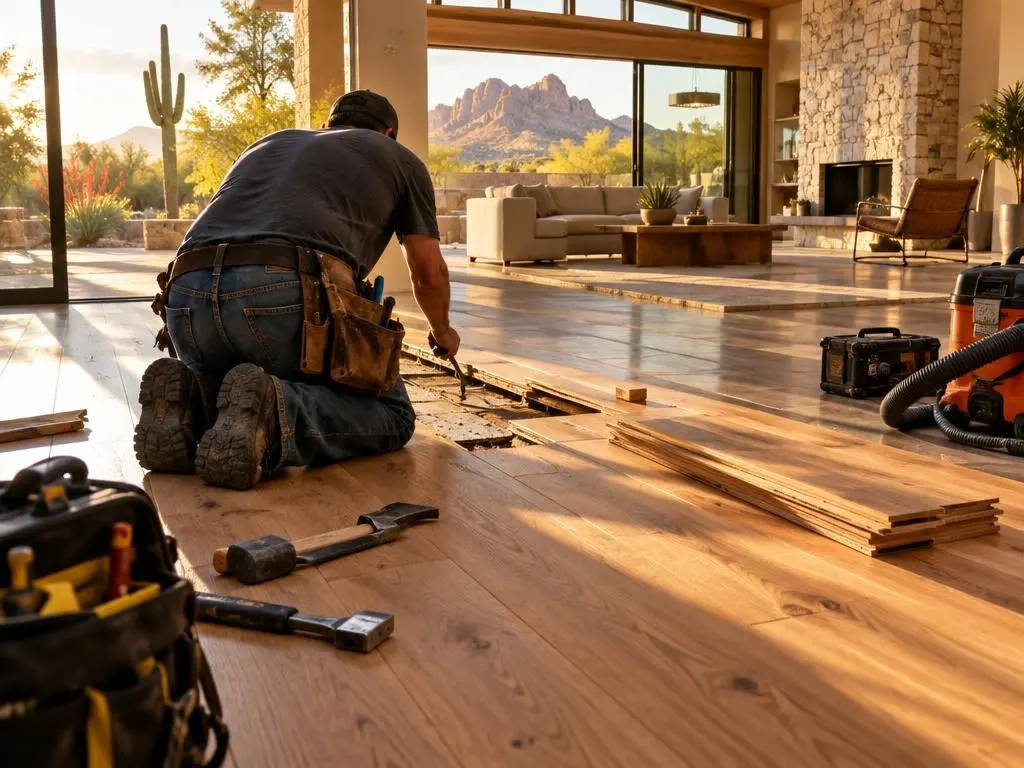
Almost every Mesa home is slab-on-grade, so engineered hardwood is our usual recommendation. It can be glued directly to the concrete once a moisture test shows the slab is within the adhesive maker's limits. Solid hardwood is still possible over a plywood subfloor system, and it does well on stairs and in rooms with a raised wood subfloor, but for most main floors here the engineered option is more stable and simpler to install.
Heat and dryness, every year
East Mesa averages 105.9°F on July afternoons, and the area sees only about 36 days of measurable rain in a year. The air inside an air-conditioned house still dries out in late spring, then picks up moisture again when summer storms roll through. Wood flooring moves with those changes. We let materials acclimate inside your home before installing, leave proper expansion space at the walls and talk through what small seasonal gaps look like so they do not come as a surprise.
Services for Mesa homeowners
- Hardwood floor installation, including tile and carpet removal
- Engineered hardwood flooring over concrete slabs
- Sand-and-refinish for worn or discolored wood floors
- Screen and recoat when the finish is dull but intact
- Board replacement after leaks, pet stains or dropped-object damage
- Hardwood stair treads and risers to match new floors
Request a written quote
Tell us roughly when the house was built and which rooms you are thinking about, and send a few photos if you can. We will come measure, check the slab and leave you a written quote with each step listed. Call (480) 565-7673 or use the form.
Mesa Background for Homeowners
- A city built in waves. Mesa had 7,224 residents in 1940, 16,790 in 1950, 33,772 in 1960 and 63,049 in 1970, then reached 504,258 at the 2020 census, so its housing stock covers many building eras.
- Hot, dry and mostly rainless. Mesa has a hot desert climate. July afternoons in East Mesa average 105.9°F (1991-2020 normals), and annual precipitation averages about 10.76 inches on roughly 36 days.
- Center Street divides the city. West Mesa and East Mesa are split by Center Street. Main Street is the main east-west arterial through downtown, near the original 1878 townsite.
- Large housing stock. Mesa had 175,701 homes in the 2010 count at about 1,405.7 per square mile, with an average household size of 2.68.
- Airfields that drew new residents. Falcon Field and Williams Field opened in the early 1940s, bringing military personnel to Mesa. Williams Air Force Base closed in 1993 and is now Phoenix-Mesa Gateway Airport.
Mesa Questions
My Mesa house is from the 1960s. Can I put hardwood over the slab?
Usually, yes. Older slabs tend to have more dips, cracks and patches, so leveling takes more time, and we test moisture before choosing a glue-down engineered floor. Floating engineered floors are another option over slabs that pass testing.
Do I have to remove my old tile first?
In most cases we recommend it. Installing over tile raises the floor height, causes trouble at doors and transitions, and hides any loose tiles that could move later. Removal and slab cleanup are listed as their own items on your quote.
Why are there gaps in my floor in May and June?
Late spring is the driest part of the year in the Phoenix area. Wood gives up moisture and shrinks, which opens small gaps between boards. They often close again when humidity rises in summer. Wide gaps that do not close, or boards that are cupping, are worth having looked at.
How far into Mesa do you travel?
We cover all of Mesa, from the west side near Tempe out to the far east side. Distance from Scottsdale is factored into scheduling, not into a surprise fee.
Free Estimates in Mesa, AZ
Free estimates anywhere in Mesa, east or west of Center Street.
Hardwood Flooring Near Mesa
- Hardwood Flooring in Scottsdale, AZ
- Hardwood Flooring in Paradise Valley, AZ
- Hardwood Flooring in Phoenix, AZ
- Hardwood Flooring in Tempe, AZ
- Hardwood Flooring in Fountain Hills, AZ
- Hardwood Flooring in Cave Creek, AZ
- Hardwood Flooring in Carefree, AZ
- Hardwood Flooring in Chandler, AZ
- Hardwood Flooring in Gilbert, AZ
- Hardwood Flooring in Rio Verde, AZ
- Hardwood Flooring in Glendale, AZ
- Hardwood Flooring in Peoria, AZ
- Hardwood Flooring in Anthem, AZ
- Hardwood Flooring in Queen Creek, AZ
- Hardwood Flooring in Gold Canyon, AZ
- Hardwood Flooring in Sun City, AZ
- Hardwood Flooring in Litchfield Park, AZ